
If you had to bet your paycheck on one team to capture attention and get people to take action… would you choose L&D or marketing?
Most people hesitate. And that tiny pause says a lot.
Marketers win the attention game every day—not because they’re smarter, but because they design for the way people actually pay attention, not the way we wish they did.
This year, Offbeat Sparks is asking a big question:
How do we design impactful learning experiences in 2026?
Here’s my take:
We start by getting honest about attention.
Why “Build It and They Will Come” Is Dead
Think about the last mandatory course your organization launched.
Someone spent weeks building slides, recording audio, loading it up in the LMS. A launch email went out. Maybe a leader intro. A due date.
Then what?
A trickle of completions. A bunch of reminders. A scramble near the deadline. And very little actual behavior change.
Most of the training we pour our hearts into is just… sitting there. Quietly collecting digital dust.
We don’t have a content problem.
We have an attention problem.
Learners in 2026 are already maxed out. Their workday is a blur of meetings, chat messages, email, tools, pop-ups, and noise. If our learning has to compete with all of that, we can’t just “make a course” and hope people find it.
The Real Culprit: Designing for the Wrong Brain
Here’s where the brain science comes in.
Everything we make has to get past a mental gatekeeper psychologists call System 1.
System 1 is fast, emotional, and automatic. It scans the world and constantly asks:
“Do I care about this right now?”
System 2—the slower, thoughtful “let me think this through” mode—only shows up after System 1 decides something is worth a closer look.
The uncomfortable truth is this:
Most training is built for System 2, but judged by System 1.
We design dense decks, long explanations, and careful logic. System 2 loves that stuff. But System 1 takes one look at a wall of bullet points in the middle of a busy day and quietly taps “Ignore.”
If we want learning to land in 2026, we have to flip the order:
- Win System 1.
- Then give System 2 something worth thinking about.
Attention first. Meaning second. Action third.
One Page That Sums It Up
To make this simple, I built the whole idea into a single visual that I’ll be using during my Offbeat Sparks session:
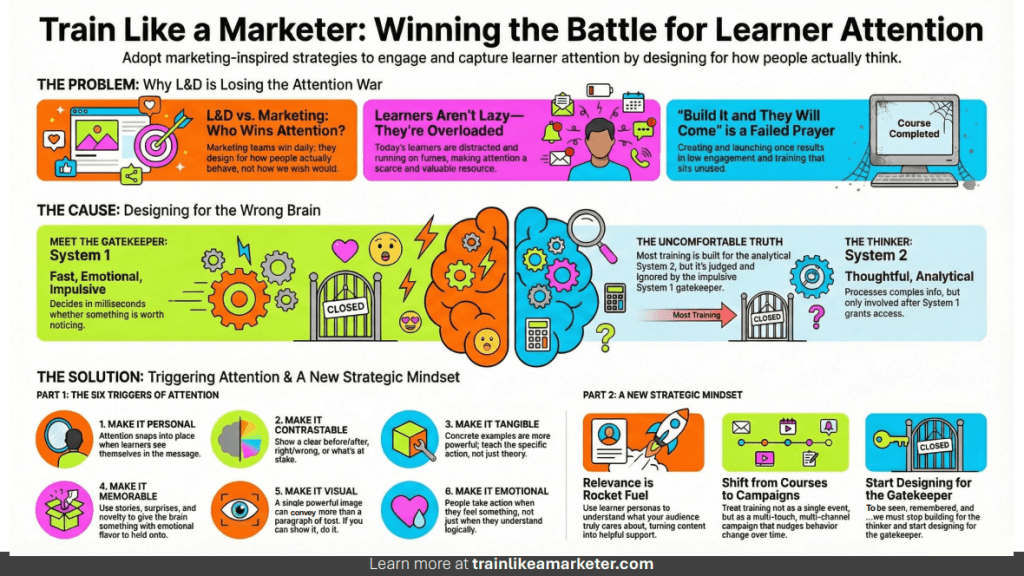
From left to right, it tells the story:
- The Problem: L&D is losing the attention war. Learners aren’t lazy; they’re overloaded. “Build it and they will come” is more like “build it and they might click it once—if we’re lucky.”
- The Cause: We’re designing for the analytical “thinker” (System 2) while ignoring the impulsive gatekeeper (System 1) that actually controls attention.
- The Solution: Trigger attention on purpose and adopt a new strategic mindset—one that looks a lot more like marketing than traditional training.
That’s the map for my session. Let’s zoom in on the solution piece.
Six Triggers That Make Learning Harder to Ignore
System 1 doesn’t respond to everything. It listens for a few specific signals.
In the session, I’ll walk through six “attention triggers” you can build straight into your learning:
- Make it personal – Generic messages disappear. The moment learners hear themselves in the story, attention snaps into place.
- Make it contrastable – Show before vs. after, wrong vs. right, risk vs. reward. The brain notices differences, not sameness.
- Make it tangible – Replace abstract labels (“be a better listener”) with concrete moments (“pause for two seconds before you respond”).
- Make it memorable – Use story, surprise, or a small dose of novelty so the idea actually sticks after the meeting ends.
- Make it visual – A single sharp visual can do more than a page of text. Our brains are wired for pictures.
- Make it emotional – We don’t change our behavior because we understand a policy. We change because something about it finally feels real.
You don’t have to use all six every time. Even two or three can move your learning from “background noise” to “wait, tell me more.”
Campaigns, Not One-Off Events
There’s one more shift that matters for 2026.
Most learning is still built as an event: a workshop, a course, a webinar. But behavior change doesn’t happen in a single moment. It happens the way good marketing works: through campaigns.
Multi-touch.
Multi-channel.
Spaced over time.
Short nudges that add up.
Instead of one shiny course launch, think:
- a simple teaser that hooks attention
- a short core experience
- follow-up stories, visuals, or prompts
- reminders and practice baked into the flow of work
In other words: stop thinking “course,” start thinking “campaign.”
So, What Does Impactful Learning in 2026 Look Like?
Impact in 2026 won’t come from more content or nicer slide templates.
It’ll come from teams who:
- design for how the brain actually works
- respect attention as a scarce resource
- use marketing-style triggers on purpose
- and build campaigns instead of single events
If you’re an L&D pro who’s tired of watching good work get ignored, this is the shift.
Join Me at Offbeat Sparks
During my Offbeat Sparks session this Friday, we’ll dig into this model, look at real examples, and explore simple ways to:
- redesign existing content to win attention
- use the six triggers in your next project
- and start thinking like a marketer without becoming one
We’ll be answering the event’s core question together:
How do we design impactful learning experiences in 2026?
My answer:
We start by training like marketers—and by designing for attention first.