
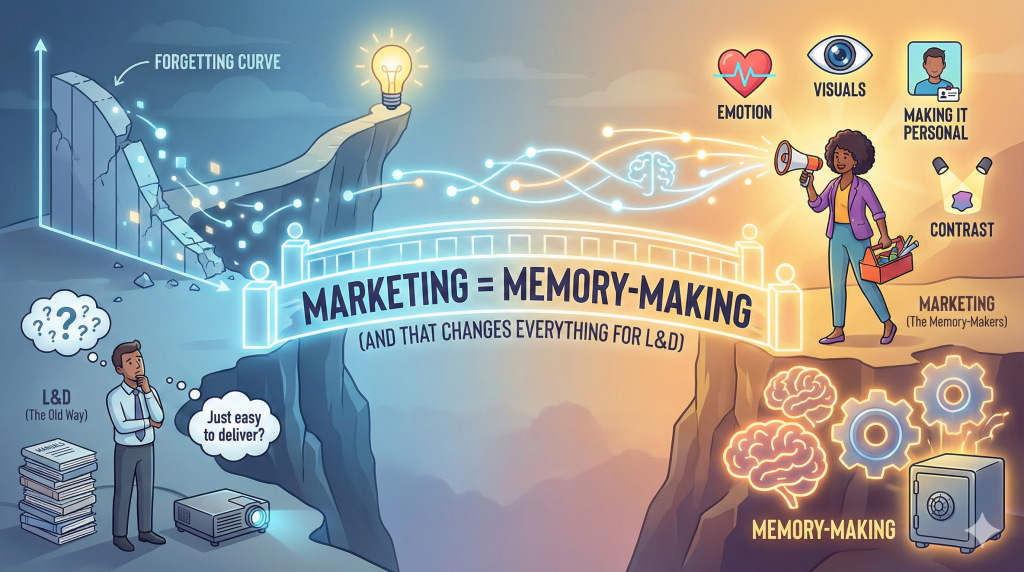
You already know about the forgetting curve. Hermann Ebbinghaus figured it out back in 1885, and it’s haunted L&D pros ever since. Without any effort to retain it, people can forget 50 to 70 percent of new information within a day. Within a week, that number climbs even higher.
If you’ve ever spent weeks building a training program only to watch learners shrug and forget most of it by Friday, you’ve lived this data firsthand. It’s not a knowledge problem. Your content was probably solid. It’s a memory problem.
Here’s where it gets interesting. There’s an entire profession that has been solving this exact problem for over a century. They just call it something different.
They call it marketing.
The Memory Problem Nobody Talks About
Stay with me here. I know “marketing” can feel like a dirty word in L&D circles. We’re educators, not salespeople. We don’t trick people — we teach them. I get it. I used to draw that same hard line.
But here’s what bugged me. L&D spends roughly $350 billion a year on training worldwide. And a huge chunk of that spend fails to move the needle on performance. We keep building training that’s thorough, well-structured, and logically sound — and learners keep forgetting most of it. Something in the approach is broken.
But strip away the buzzwords and the bad rep, and you’ll find that marketing and L&D share the same core challenge: get someone’s attention, make something stick in their brain, and change what they do next.
That’s not selling. That’s memory-making.
Cognitive psychologists have known for decades that how deeply we process information shapes how well we recall it. Craik and Lockhart’s levels-of-processing framework (1972) showed that info processed at a deeper, more meaningful level creates stronger memory traces. Shallow processing — like reading a slide or sitting through a lecture — barely leaves a mark.
Marketers figured this out the hard way. They couldn’t afford shallow processing. Nobody is required to remember a brand the way workers are required to complete compliance training. (And let’s be honest — how well does that “required” part really work?) So marketers had to reverse-engineer memory itself.
And what they found lines up almost perfectly with what learning science tells us about how memories form and last.
The Toolkit Hiding in Plain Sight
Let’s walk through a few examples.
Emotion drives encoding. Neuroscientist Elizabeth Phelps (2006) showed that emotions play a key role in how memories form and how we make choices. The emotional boost to memory means that people recall info tied to feelings more vividly and clearly than neutral content. Antonio Damasio put it even more bluntly: “We are not thinking machines that feel. We are feeling machines that think.”
Marketers have known this forever. That Subaru ad doesn’t lead with horsepower specs. It shows a dad watching his kid drive away for the first time. It makes you feel something — and then you remember the brand.
Now think about the last training module you built. Did it make anyone feel anything? Or was it a clean, logical info dump that checked all the boxes and left zero trace?
Visuals beat text for retention. The picture superiority effect, first shown by Paivio and Csapo (1973), tells us that people remember images far better than words alone. Our brains can pull meaning from a picture in as little as 13 milliseconds (Potter et al., 2014) — roughly ten times faster than a single word. When we see an image, our brains build a mental model that includes the visual details and the feelings and context that come with it. That layered encoding helps land info in long-term memory.
Every great ad relies on this. Think about the brands you recall most clearly. You’re probably seeing something in your mind — not reading a tagline word for word.
Yet most training still leans hard on text-packed slides and bulleted handouts. We’re fighting the forgetting curve with the one tool that’s proven to be the least useful.
Making it personal signals that it matters. Studies show that content tailored to the reader leads to longer attention spans, better recall, and more willingness to engage (Tam and Ho, 2006; Kalyanaraman and Sundar, 2006). This makes sense when you think about how the brain sorts incoming data. We’re always filing things into two bins: matters to me and doesn’t matter to me. Content that feels relevant gets the green light for deeper processing. Generic content gets tossed.
Marketers obsess over this because messages that feel generic get ignored. Period. They build detailed buyer personas. They map out customer journeys. They tailor each message to specific needs, pain points, and goals.
L&D pros could do the same thing with learner personas and journey mapping — but most don’t. We tend to build for the average learner, which means we’re really building for no one.
Contrast grabs attention. Our brains are wired to notice what’s different. The Heath brothers explored this in Made to Stick (2007) — things that stand out from their surroundings get flagged as important. Marketers use this all the time through visual contrast, surprising stats, before-and-after stories, and pattern breaks.
In training, we often do the reverse. We create uniform, steady experiences where every module looks and feels the same. There’s nothing for the brain to flag as worth noting. Nothing breaks the pattern. And so nothing sticks.
It’s Not About Being Salesy
Here’s the thing that finally clicked for me: every one of these marketing moves exists because it solves a memory problem. Emotion, visuals, making it personal, contrast — they aren’t tricks to get people to buy things they don’t need. They’re tools that work with the brain’s natural wiring rather than against it.
That’s what L&D needs. Not the cartoon version of marketing with flashy slogans and pushy sales pitches. The real version — the one built on decades of research into how people actually pay attention, process info, and remember things.
When I stopped thinking of marketing as “selling” and started thinking of it as “memory-making,” it changed how I approach every learning design. Each choice became a question about encoding: Will this spark a feeling? Does this feel relevant to this learner? Am I using visuals or just piling on more text? Is there enough contrast to signal what matters most?
We explored this connection in depth in our book Think Like a Marketer, Train Like an L&D Pro. But you don’t need a book to start. You just need to ask yourself one question the next time you sit down to design a learning experience:
Am I making this easy to remember — or just easy to deliver?
If your learners can’t recall it, nothing else matters. And the people who’ve spent the last century figuring out how to be remembered? They’ve got a few ideas worth borrowing.
If this kind of thinking hits home, you’ll probably enjoy our book Think Like a Marketer, Train Like an L&D. It’s packed with practical, real-world ideas to help you make your learning clearer, sharper, and a whole lot more effective.