
You’ve probably written a sentence like this:
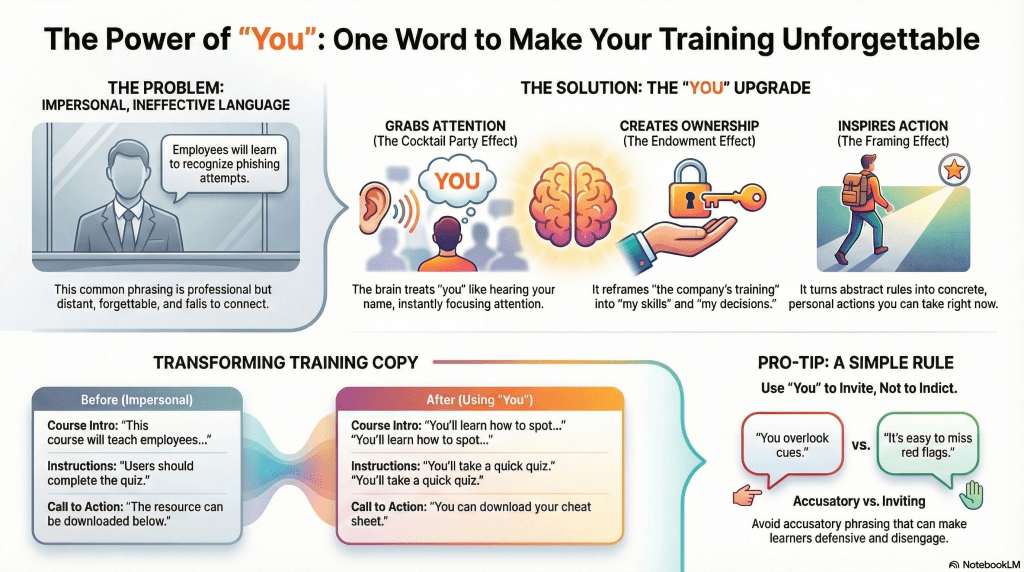
“Employees will learn to recognize phishing attempts.”
It sounds fine. Professional. Harmless.
It’s also completely forgettable.
Change just a few words:
“You’ll learn how to spot the phishing tricks attackers use every day.”
Now it feels different, right?
Closer. Warmer. A little more real.
That tiny shift comes down to one tiny word: you.
Not “learners.”
Not “employees.”
Not “users.”
Just you.
And as simple as it looks, there’s solid research showing why this one pronoun can make your training more engaging, more memorable, and even more persuasive.
The Research: Why “You” Works Better Than “People”
A study in the Journal of Interactive Marketing tested versions of posts, headlines, and short messages. Some used generic language like “consumers” or “people.” Others used “you” and “your.”
The “you” versions consistently did better.
People who read “you”:
Paid more attention
Felt more personally involved
Rated the brand more favorably
The words were almost identical.
The only real difference was whether the message sounded like it was talking about people in general—or talking directly to you.
So what’s going on?
The Psychology Under the Hood
Three things are happening at once.
1. Your attention snaps to anything about “you”
This is the Cocktail Party Effect in action.
In a noisy room, you still notice when someone says your name.
On a noisy screen, your brain does something similar with “you.”
It treats it as a tiny tap on the shoulder:
“Hey. This is about you. Wake up.”
That’s what your learners’ brains are doing, too.
2. “You” creates a sense of ownership
We tend to value things more when we feel like they’re ours.
That’s the Endowment Effect.
“You” language gives learners subtle ownership over the content:
- your data
- your team
- your next step
It doesn’t feel like “the company’s training.”
It feels like “my skills,” “my decisions,” “my risk.”
That’s a big shift.
3. “You” reframes abstract advice into concrete action
The Framing Effect tells us that how we say something shapes how people interpret it.
Compare:
“Employees should report suspicious emails immediately.”
“If something feels off, you can report it with one click.”
The first is a rule.
The second is a nudge.
Both are saying the same thing.
Only one makes it obvious what you should do next.
A quick aside: If you want to feel how a small shift in wording can completely change how people respond, this short video from Daniel Pink nails it. It’s a simple, powerful reminder that the right words don’t just inform people — they move them.
How This Plays Out in Real Training
Let’s run through some quick before/after examples.
Course Intros
❌ “This course will teach employees how to identify ransomware attacks.”
✅ “You’ll learn how to spot ransomware before it locks up your files.”
Scenario Setups
❌ “A manager receives a suspicious invoice email.”
✅ “You get an invoice email that looks legit… but something’s off.”
Prompts and Instructions
❌ “Users should complete the quiz to test their knowledge.”
✅ “You’ll take a quick quiz to check what’s sticking so far.”
Calls to Action
❌ “The resource can be downloaded below.”
✅ “You can download your cheat sheet below.”
Individually, these changes seem small.
But together, they move your learner from “watching content happen” to “being inside the story.”
That’s where behavior change actually starts.
The Tension: When “You” Goes Too Far
Now for the uncomfortable bit.
“You” is powerful.
And like anything powerful, it can backfire.
Sometimes “you” invites.
Sometimes it accuses.
Look at this line:
“You often overlook critical phishing cues.”
If a confident, experienced employee reads that, it might feel like a cheap shot.
They’ll push back in their head:
“Actually, I don’t. I’m pretty good at this.”
Here’s a simple rule of thumb:
Use “you” to invite, not indict.
When the message might feel like blame, try softening the frame:
“Even experienced people miss phishing cues when they’re busy.”
“It’s easy to miss small red flags when you’re moving fast.”
Then you can move back into “you” once the learner feels respected:
“In this module, you’ll practice spotting those subtle clues before you click.”
There’s also a cultural nuance: in more individualistic cultures, “you” feels empowering. In more collectivist cultures, “we” or “our team” may land better. It’s worth being intentional.
A Simple “You-Test” for Your Next Course
You don’t need to rewrite everything you’ve ever built.
Just run a small experiment.
Pick one existing course.
Find three spots:
- the course intro
- one scenario
- one call to action
Rewrite each using “you” and “your.”
Read them out loud. Ask yourself:
- Does this feel more personal?
- Does it feel inviting—or pushy?
- Would I talk this way in a conversation?
If you work with a team, share your before/after versions and ask:
“Which one feels like it was written for you, not just for ‘employees’?”
That discussion alone is worth the price of admission.
Bringing It Back to the Bigger Picture
This is a tiny example of a bigger idea I care a lot about:
The best learning designers don’t just teach.
They persuade.
They use the same tools great marketers use—attention triggers, framing, simple language—but they aim them at better decisions and better behavior on the job.
If that’s the kind of work you want to be doing more of, this is one of those small tweaks that punches way above its weight.
And if this resonates, you’ll find a lot more of this thinking in Think Like a Marketer, Train Like an L&D Pro—because when you blend good science with smart copy, your content does more than inform.
It actually moves people.