
I got a gift after a recent webinar.
Not a mug. Not a badge. Not one of those “Thanks for presenting” emails with the energy of a damp paper towel.
I got the chat log.
And if you have ever led a webinar, workshop, or training session, you know the chat is where the real truth lives.
The slides are planned.
The script is polished.
The chat is the live wire.
It shows what people noticed. What confused them. What made them laugh. What made them think, “Oh no, this is my problem.”
And that is exactly what happened.
The webinar was about using marketing principles to make training more engaging, useful, and hard to ignore. The big idea comes straight from my book, Think Like a Marketer, Train Like an L&D Pro:
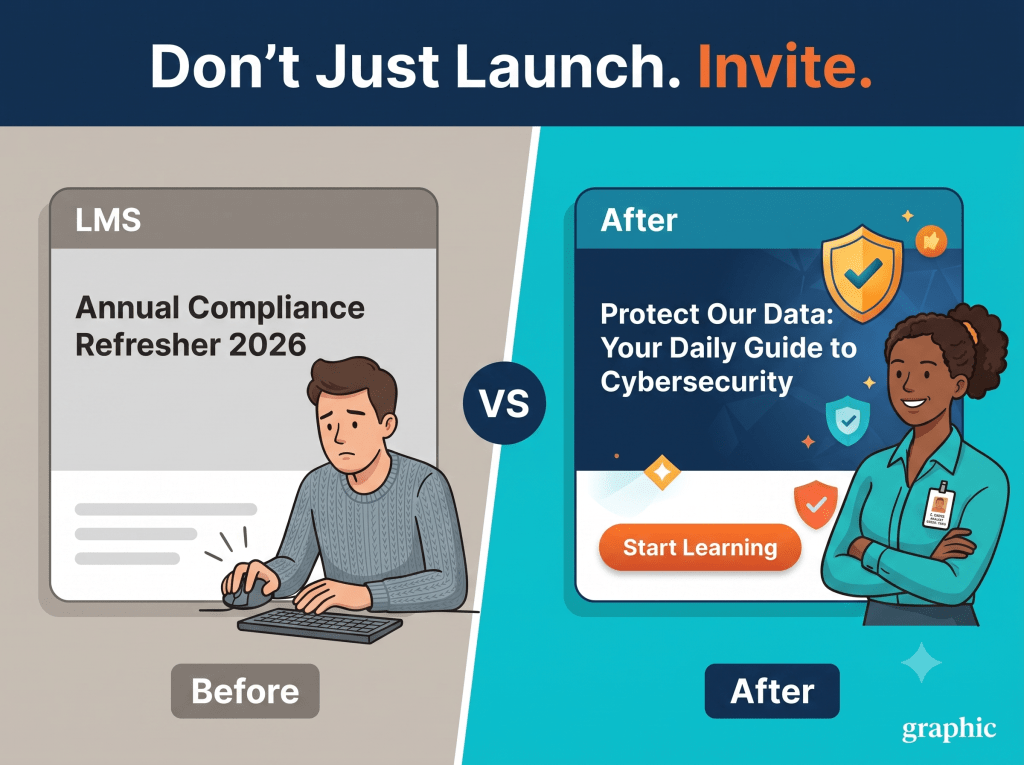
Training does not fail only because the content is bad. Sometimes it fails because the invitation is bad.
That is a hard truth for L&D.
We spend so much time building the thing. The course. The job aid. The video. The workshop. The LMS page. The quiz. The resource hub.
Then we announce it with something like:
“Annual Compliance Refresher 2026 is now available.”
Come on.
Nobody is sprinting through the halls for that.
The Chat Told the Real Story
Early in the webinar, I asked people what made a marketing example work.
The answers came fast:
Visual.
Simple.
Call to action.
Fewer words.
Eye-catching.
Bold.
Attention-grabbing.
That was not just participation. That was diagnosis.
People know what gets attention. They see it every day as consumers. They respond to strong headlines, clear value, emotion, contrast, and simple choices.
Then many of those same people go back to work and publish training called:
“Information Security Awareness Module 4.”
This is the gap.
As consumers, we know what works.
As L&D pros, we often pretend that people become more patient, focused, and rational the second they see a course tile in the LMS.
They do not.
They are still busy. Still distracted. Still scanning. Still asking one brutal question:
“Why should I care?”
If your training doesn’t answer that quickly, people move on.
The First Lesson: Start Before the Course
One of the strongest themes in the chat was course titles.
Someone wrote, “I need a marketer to rename my trainings.”
Another said they wanted to work on “titles and notices.” Someone else mentioned course descriptions on their website.
That is the work.
Not glamorous. Not fancy. But powerful.
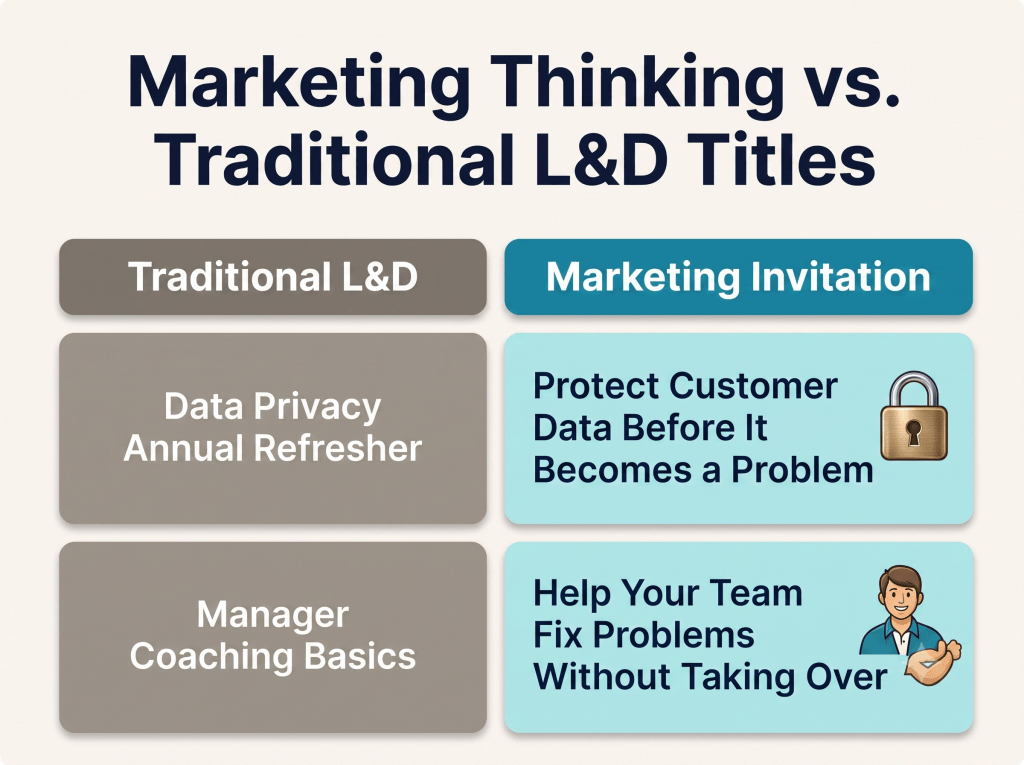
A course title is not a label. It is a tiny ad.
It has one job: make the right person want to keep reading.
That does not mean we turn every title into clickbait. We are not writing “You Won’t Believe What This Spreadsheet Did Next.”
But we do need to make the value clear.
Instead of:
“Data Privacy Annual Refresher”
Try:
“Protect Customer Data Before It Becomes a Problem”
Instead of:
“Cybersecurity Awareness Training”
Try:
“Stop the Clicks That Put Your Team at Risk”
Instead of:
“Manager Coaching Basics”
Try:
“Help Your Team Fix Problems Without Taking Over”
The better versions do not just name the topic. They point to the outcome.
That is marketing thinking.
And it is also good instructional design.
The Second Lesson: Simple Wins
One person in the chat said, “Simple gets me every time.”
Same.
Simple is not shallow. Simple is kind.
The brain loves clarity because it saves energy. When something is easy to process, it feels more true, more useful, and more worth our time.
This is one of the core ideas in my book: if you want people to engage, reduce the mental friction.
That means fewer words. Cleaner visuals. Stronger hierarchy. More obvious next steps.
It also means not making people decode your message.
Too much training communication sounds like it was written by a committee trapped inside a policy binder.
“Learners will gain awareness of required protocols related to organizational standards and role-specific compliance expectations.”
Technically accurate. Emotionally dead.
Try this instead:
“Know what to do before a small mistake becomes a big mess.”
That line has a pulse.
The Third Lesson: Make It Personal
A big moment in the webinar came from a comparison between a weak, generic message and a stronger, emotional one.
The chat lit up.
People said things like:
| Weak generic messaging | Strong emotional messaging |
|---|---|
| “Boring.” “I tuned out.” “Blah, blah, blah.” | “Goosebumps.” “Relief.” “Very simple takeaway.” |
That is the difference between information and meaning.
People do not care about “vehicle safety features” in the abstract.
They care about walking away from the crash.
They care about getting home.
They care about the people in the back seat.
The same applies to training.
People do not care about “password requirements.”
They care about not being the person whose hacked account causes a breach.
They do not care about “data handling standards.”
They care about not exposing a customer, patient, student, or coworker to harm.
They do not care about “leadership communication competencies.”
They care about having a hard conversation without making it worse.
Make it personal, and the message gets heavier. In a good way.
The Fourth Lesson: Stakeholders May Be the Real Audience
One comment in the chat may have been the most important one.
Someone said that when they try to make these kinds of changes, the learners are not the problem. The stakeholders are.
The stakeholders want the old structure. The formal objectives. The same order. The same facts. The same safe, stiff format.
That is real.
And it is where many good training ideas go to die.
So part of our job is not just designing better training. It is helping stakeholders understand why better messaging matters.
Here is the line I would use:
“If people ignore the training, the instructional design never gets a chance to work.”
That is the argument.
You are not making training “cute.”
You are making it more likely to be noticed, understood, remembered, and used.
That is not decoration. That is performance strategy.
The Fifth Lesson: Give People a Place to Start
Near the end, someone wrote that they wanted to try everything and did not know where to start.
That is a good sign. It means the ideas created energy.
But energy without a next step turns into fog.
So here is the simple starting point.
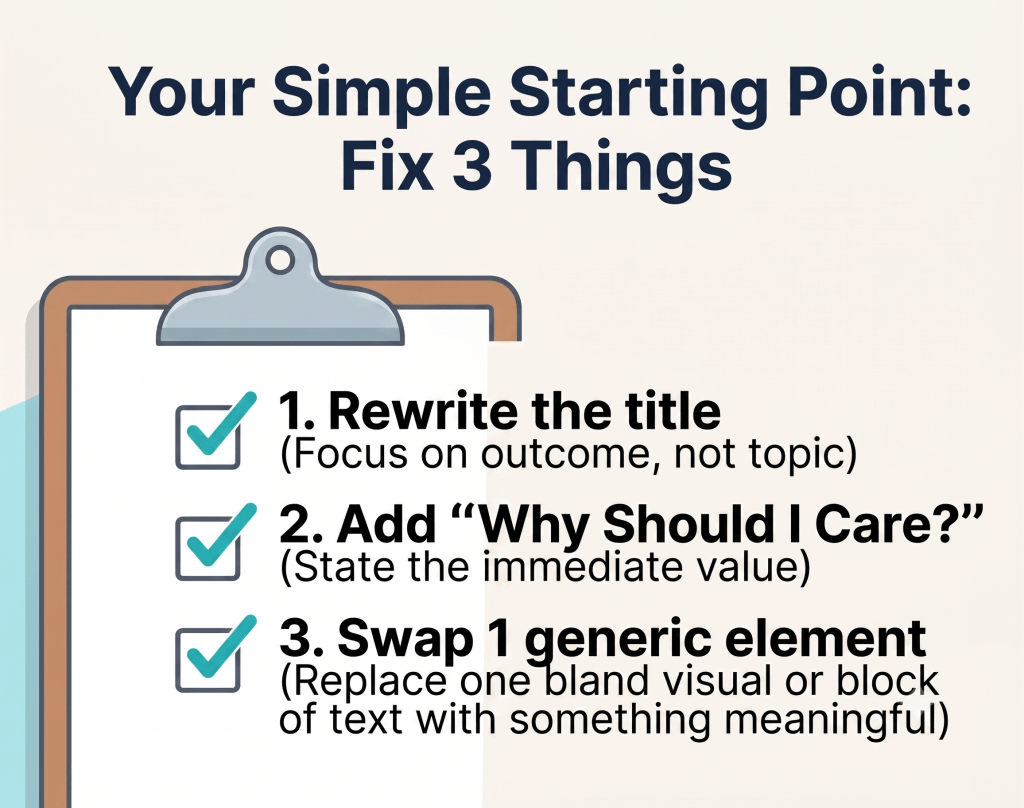
Pick one piece of training and fix three things:
- Rewrite the title so it points to a real outcome.
- Add one sentence that answers, “Why should I care?”
- Replace one generic visual or block of text with something concrete, personal, or emotional.
That is it.
Do not redesign the whole ecosystem this week.
Start with the invitation.
Because before people can learn from your training, they have to choose to give it attention.
The Big Takeaway
The chat log reminded me of something easy to forget.
People are not begging for more training.
They are begging for training that respects their time.
Training that gets to the point.
Training that feels useful.
Training that looks like it was made for a real human with a full calendar and a tired brain.
That is what marketers understand.
Attention comes first.
Then value.
Then action.
L&D needs all three.
Because the best course in the world still has a problem if nobody wants to open it.
So the next time you launch a course, write an email, build a resource page, or name a webinar, pause before you publish.
Ask the marketer’s question:
Would this make me want to keep going?
If the honest answer is no, fix the invitation first.
If this kind of thinking hits home, you’ll probably enjoy our book Think Like a Marketer, Train Like an L&D. It’s packed with practical, real-world ideas to help you make your learning clearer, sharper, and a whole lot more effective.