
One approach works with the human brain. The other works against it.
We’ve been studying some of the most effective marketing campaigns of the last decade — Airbnb, Spotify, Dove.
Different industries. Different budgets. Wildly different goals.
But the same underlying move.
None of them push information. They pull people into a narrative.
That one distinction explains a lot about why so much workplace training underperforms — no matter how well it’s designed. Organizations spend more than $350 billion globally on training each year, but only a fraction of that investment results in improved performance. The problem usually isn’t the content. It’s the approach.
What Marketing Gets That L&D Often Doesn’t
A campaign isn’t a collection of assets. It’s a story with momentum.
Take Spotify Wrapped. On the surface, it’s just data — listening stats, minutes, top artists. But that’s not why it spreads across every social feed every December.
It works because it makes you the protagonist. It’s emotionally charged — identity, nostalgia, belonging. It’s built to be shared. And it unfolds over time, building anticipation before it even drops.
Now compare that to the average annual compliance module.
Same basic concept: here’s some information you need.
Completely different experience.
One feels like a reveal. The other feels like a requirement. And the human brain responds to those two things very differently — a fact that neuroscience has been confirming for decades.
Campaigns Are Built for Humans. Training Is Often Built for Delivery.
Look at Dove’s Real Beauty campaign. It wasn’t selling soap. It was reframing a belief about what beauty actually looks like.
“We are not thinking machines that feel. We are feeling machines that think.”
– Neuroscientist Antonio Damasio
Neuroscientist Antonio Damasio put it plainly: “We are not thinking machines that feel. We are feeling machines that think.” Great campaigns are built on that truth. They don’t lead with logic. They lead with emotion — and let the logic follow.
That’s what great campaigns do:
- They identify a tension that already exists in people’s minds
- They challenge an assumption people didn’t know they were making
- They create emotional contrast — old belief, new possibility
- They reinforce the message across multiple touchpoints over time
Meanwhile, a typical training program:
- Defines objectives
- Presents content
- Adds a quiz
- Moves on
One builds meaning. One checks a box. And learners know the difference — even when they can’t articulate why one stuck and the other didn’t.
What Would You Ask If You Designed Learning Like a Campaign?
You’d start with completely different questions.
Instead of “What content do we need to cover?” you’d ask:
- What belief needs to shift?
- What tension are we surfacing?
- Who is the hero of this story — and it’s not the subject matter expert?
- What’s the narrative arc across the full experience?
- Where does emotion enter the picture?
Those questions change everything about how you design, sequence, and deliver learning. They’re also the foundation of the framework in Think Like a Marketer, Train Like an L&D Pro — a book built on the argument that effective learning isn’t about content coverage. It’s about attention, memory, and behavior change. Campaign thinking forces you to design for all three.
A Practical Move You Can Make This Week
Before launching your next program, write one sentence:
“This experience helps ___ move from ___ to ___.”
If you can’t complete that clearly, you don’t have a story. You have content.
Then map your rollout like a campaign:
- Tease — spark curiosity before launch, not the morning of
- Launch — create a moment worth noticing, not just another calendar invite
- Reinforce — repeat the core message across channels and over time, not just once
- Social proof — show participation publicly so others feel the pull to join
- Sustain — design intentionally for after completion, because that’s when behavior change actually happens
That’s marketing sequencing. It’s also smarter learning design.
The Uncomfortable Truth
Instructional design is full of genuinely smart people. But smart doesn’t automatically mean compelling.
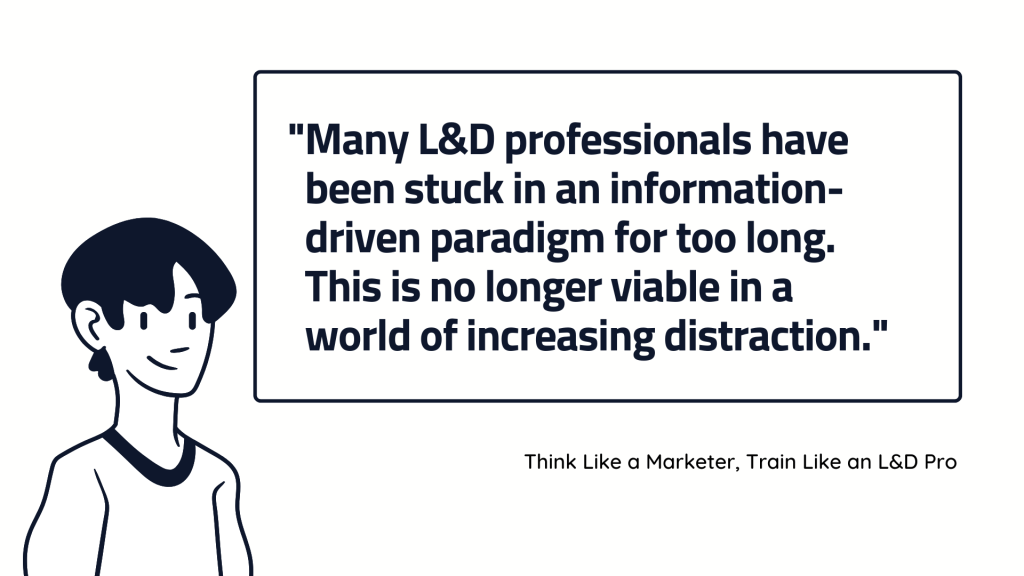
As Bianca and I write in Think Like a Marketer, Train Like an L&D Pro: “Many L&D professionals have been stuck in an information-driven paradigm for too long. This is no longer viable in a world of increasing distraction.”
Marketers never get to assume attention. Every campaign has to earn it. Compliance isn’t the same as attention. And attention is where learning actually starts.
If your programs have to compete with everything else fighting for space on someone’s screen — and they do — then designing them like something worth choosing isn’t optional. It’s the whole job.
This Is Exactly What the Book Is For
The shift from pushing content to crafting narrative is at the heart of Think Like a Marketer, Train Like an L&D Pro.
You’ll get the complete attention framework, six research-backed triggers that make content stick, tools for building learner personas, campaign-style rollout strategies, and real-world applications — whether you’re designing a one-hour module or an enterprise-wide program.
Better learning isn’t built from more content.
It’s designed from a deeper understanding of how attention, memory, and motivation actually work.
Get the book and start designing learning people actually want →