
And why the research keeps proving it
If you’ve ever watched learners’ eyes glaze over halfway through a paragraph, you already know this:
When the words get harder, the learning gets slower.
It’s not that people are lazy or bad at paying attention. It’s that the human brain is wired to favor whatever feels easy to process.
Back in the early readability boom, researchers started noticing something interesting: clearer text consistently leads to better comprehension and faster learning (DuBay, 2004). Even though some early studies are hard to pin down now, the modern research is clear — readability matters because the brain hates friction.
Let’s look at the science behind that idea, plus what it means for learning designers who want to make content easier to understand, remember, and act on.
The Big Idea: Readability as “Friction Control”
When we talk about readability, we’re not just talking about shorter sentences or fewer fancy words.
We’re talking about reducing extraneous effort — the mental scrubbing learners have to do just to figure out what the text means.
This idea fits perfectly with Cognitive Load Theory, which says that when people spend unnecessary mental energy deciphering complex text, they have less mental bandwidth left for actual learning (Sweller, 1988).
And cognitive load isn’t the only piece of the puzzle.
Why Readable Text Helps People Learn Faster

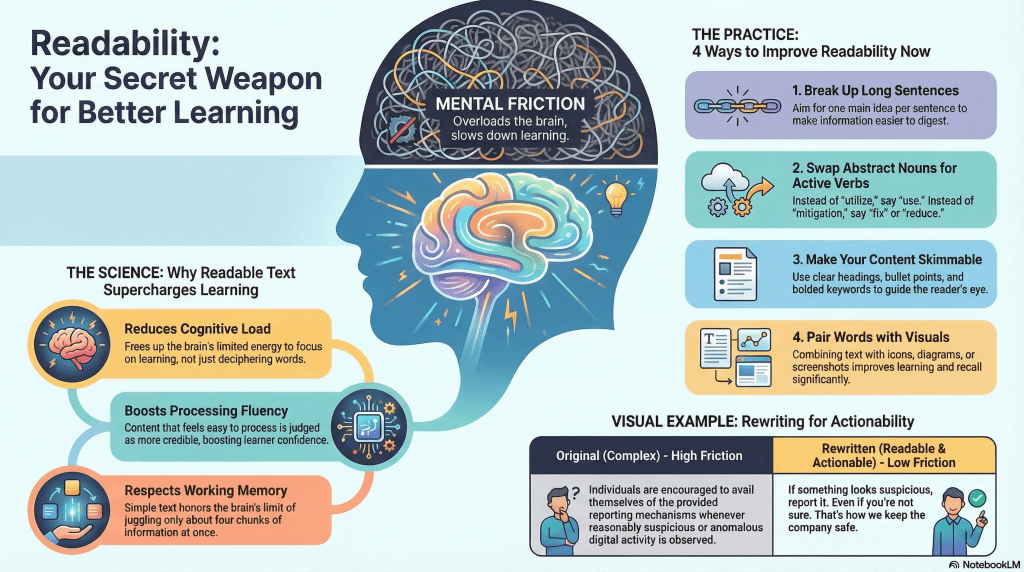
1. Cognitive Load: Don’t Waste the Brain’s Battery
We all know learners have limited mental capacity. Cognitive Load Theory tells us that:
- Intrinsic load = complexity of the content
- Extraneous load = unnecessary mental work caused by the way information is presented
Hard-to-read text jacks up extraneous load. Clear, readable text lowers it (Sweller, 1988; DuBay, 2004).
Readable writing doesn’t dumb down content. It stops making simple ideas feel hard.
2. Processing Fluency: Easy Feels True
Psychologists call it processing fluency — how easy or smooth it is for the brain to handle text.
Research shows that when something is easier to process, people judge it as more credible, more understandable, and less risky (Reber, Schwarz, & Winkielman, 2004).
That means:
- If your text is readable, learners think, “Okay, this makes sense.”
- If your text is complex and dense, they think, “This is confusing. I must not understand this topic.”
Fluency doesn’t just help comprehension. It boosts confidence, which is major for learning.
3. Working Memory: Only a Few Slots Available
Cowan’s research on working memory is blunt: humans can only juggle about four chunks of information at once (Cowan, 2001).
A long, complicated sentence can burn all four slots immediately.
Readable text respects those limits:
- one idea per sentence
- one idea per paragraph
- simple, familiar words
- clean structure with clear links
Less juggling = more learning.
4. Plain Language Improves Real-World Results
Decades of plain language research show that clear writing improves:
- comprehension
- recall
- error reduction
- compliance and follow-through
This is true across healthcare, government, and technology (Redish, 2012; National Academies of Sciences, 2019).
Readable text isn’t “nice to have.” It’s a proven way to help people understand and act.
Where Readability Scores Help — and Where They Don’t
What scores like Flesch and SMOG are good at
They catch:
- long, tangled sentences
- dense noun stacks
- excessive jargon
- missing structure
- overly complex vocabulary
.
Those patterns absolutely make learning harder (DuBay, 2004).
What they completely miss
Research from the Coh-Metrix team (McNamara, Graesser, McCarthy, & Cai, 2014) shows that readability formulas do not measure:
- coherence
- logic flow
- conceptual difficulty
- relevance
- learner motivation
- examples or visuals
- instructional design quality
So we land here:
Readability is a helpful proxy for ease of learning — but not the whole story.
It’s a flashlight, not a scoreboard.
How Readability Connects to SURE and Accessibility
Readable writing aligns perfectly with our SURE model — especially the “E”:
- E = Easy to skim.
Easy to skim usually means easy to learn.
Accessibility research and WCAG 2.2 guidelines push for the same patterns:
- clear headings
- predictable structure
- short paragraphs
- simple phrasing
- strong contrast
- meaningful links
.
Readable writing is also accessible writing (W3C, 2023). That means it helps:
- non-native speakers
- people with ADHD
- dyslexic learners
- stressed or tired employees
- mobile-first learners
In other words: pretty much everyone.
Before and After Examples
Here’s how readability directly shows up in actual workplace learning.
Example 1: Security Concept
Before:
“Effective cyber hygiene practices should be operationalized through the consistent application of robust password management standards and an ongoing vigilance toward evolving threat vectors.”
After:
“Good cyber hygiene starts with two habits: strong passwords and paying attention to new threats. Do those well, and you’re already ahead of most attacks.”
Readable = learnable.
Example 2: Reporting Instructions
Before:
“Individuals are encouraged to avail themselves of the provided reporting mechanisms whenever reasonably suspicious or anomalous digital activity is observed.”
After:
“If something looks suspicious, report it. Even if you’re not sure. That’s how we keep the company safe.”
Readable = actionable.
Example 3: Learning Objective
Before:
“Learners will demonstrate the capacity to effectively identify and mitigate operational-level security exposures using prescribed organizational methodologies.”
After:
“You’ll learn how to spot security risks at work — and what to do about them.”
Readable = memorable.
How to Make Your Learning More Readable (Without Dumbing Anything Down)
1. Check the score — but don’t worship it
Aim for Flesch Reading Ease 55+ for general audiences. Then read your text out loud.
If your tongue trips, your learners will too.
2. Break long sentences into two or three
One idea per sentence. If a sentence has more than one “and,” it probably needs to split.
3. Swap abstract nouns for concrete verbs
Instead of:
- mitigate
- operationalize
- remediate
- utilize
Use:
- fix
- use
- reduce
- prevent
Your learners will thank you.
4. Make content skimmable (hello, SURE)
Help your future self:
- clear headings
- bullets
- short paragraphs
- bold key points
- visuals that actually help
If someone can skim your page and tell you the point in 10 seconds, your readability is on track.
5. Pair words with visuals
Dual coding is powerful. Words + visuals improve learning and recall (Mayer, 2009; Paivio, 1986).
Screenshots, diagrams, icons — all reduce cognitive load.
6. Test with real humans
Ask one question:
“What is this trying to teach you?”
If they can’t answer in one sentence, it’s not them — it’s your wording.
So…Is Readability Really a Proxy for Ease of Learning?
Short answer: Yes — a very useful one.
It’s not the only thing that matters. But when your words are easier to read:
- learners understand faster
- they remember more
- they feel more confident
- they make fewer mistakes
- they’re more likely to act
Readable writing isn’t about simplicity. It’s about clarity.
And clarity is what learning design is all about.
References
- Cowan, N. (2001). The magical number 4 in short-term memory: A reconsideration of mental storage capacity. Behavioral and Brain Sciences, 24(1), 87–185.
- DuBay, W. H. (2004). The Principles of Readability.
- Mayer, R. E. (2009). Multimedia Learning (2nd ed.). Cambridge University Press.
- McNamara, D. S., Graesser, A. C., McCarthy, P. M., & Cai, Z. (2014). Automated Evaluation of Text and Discourse with Coh-Metrix. Cambridge University Press.
- National Academies of Sciences, Engineering, and Medicine. (2019). Revising the Plain Writing Act and Improving Health Communication.
- Paivio, A. (1986). Mental Representations: A Dual Coding Approach. Oxford University Press.
- Redish, J. (2012). Letting Go of the Words: Writing Web Content That Works (2nd ed.). Elsevier.
- Reber, R., Schwarz, N., & Winkielman, P. (2004). Processing fluency and aesthetic pleasure. Personality and Social Psychology Review, 8(4), 364–382.
- Sweller, J. (1988). Cognitive load during problem solving: Effects on learning. Cognitive Science, 12(2), 257–285.
- World Wide Web Consortium (W3C). (2023). WCAG 2.2 Guidelines.
If this kind of thinking hits home, you’ll probably enjoy our book Think Like a Marketer, Train Like an L&D. It’s packed with practical, real-world ideas to help you make your learning clearer, sharper, and a whole lot more effective.